
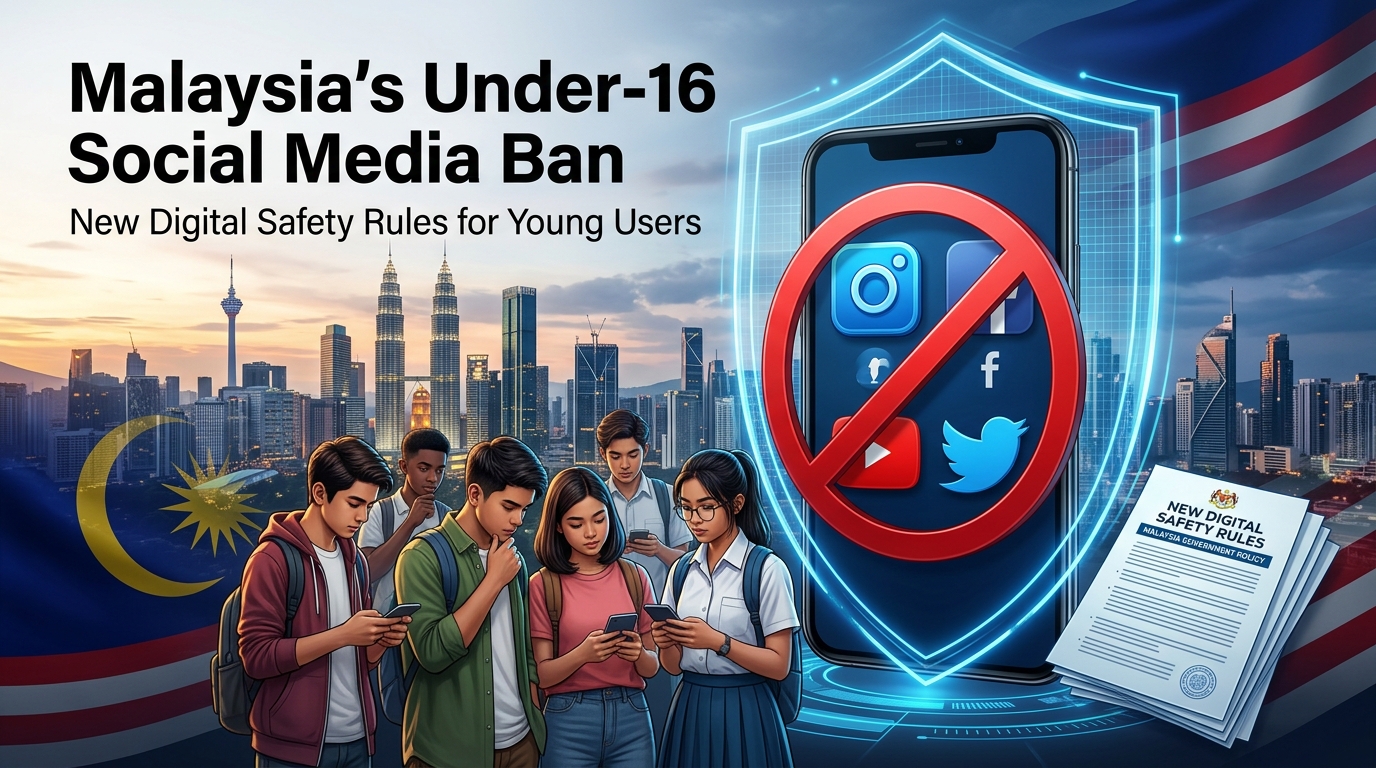
Malaysia’s Under-16 Social Media Ban
Malaysia has begun enforcing mandatory age verification for social media users, barring children under 16 from opening new accounts and requiring all existing users to confirm their identities using official government documents. The measures took effect under the Online Safety Act 2025 (ONSA), implemented by the Malaysian Communications and Multimedia Commission (MCMC).
The enforcement officially began on June 1, 2026. The Online Safety Act received royal assent in May 2025, and policymakers later raised the proposed minimum age for social media registration from 13 to 16 before finalizing the framework.
📋 Legal Framework
Malaysia is implementing this through two regulatory instruments:
The measures take effect under the Child Protection Code (CPC) and Risk Mitigation Code (RMC), regulatory codes issued by the Malaysian Communications and Multimedia Commission (MCMC) under the Online Safety Act 2025 (ONSA).
The rules make an important distinction: ONSA defines a child as anyone under 18, but platforms must specifically prevent users under 16 from registering accounts. Existing users must also complete age verification.
📱 Which Platforms Are Affected?
Social media platforms with at least 8 million users — including Instagram, TikTok, YouTube, and gaming platforms such as Roblox — are required to ensure that only users aged 16 and above can register accounts and access features. Facebook is also included, given its massive user base in the country.
🪪 How Age Verification Works
Age verification must be conducted using government-issued records or equivalent documents recognised by Malaysian authorities, including identity cards and passports.
Age verification for existing users will be rolled out progressively over the next six months. Users identified as under 16 will have one month to download or transfer their data — including photos and videos — before any restrictions, suspensions or other actions are applied.
⚖️ Penalties for Non-Compliance
Platforms that fail to comply can face regulatory action and financial penalties of up to RM10 million (approximately US$2.5 million).
Notably, parents and guardians will not face penalties for non-compliance — penalties are directed at the platforms, not families.
🚨 Why Malaysia Did This — The Child Safety Crisis
The scale of online harm against children in Malaysia drove this policy:
The MCMC identified cyberbullying, online harassment, and child sexual abuse material (CSAM) as key threats. Malaysia recorded 12,656 reports of CSAM in the first half of 2025 alone, according to data from the Internet Watch Foundation. Meanwhile, some 100,000 Malaysian children aged 12 to 17
🌍 Global Context
Malaysia is part of a growing wave of nations restricting children’s access to social media:
- Australia became the first country to fully enforce a social media ban for under-16s in December 2025, with potential fines up to US$33 million (A$50 million) for platforms.
- Indonesia set a regional precedent in March 2026, enforcing restrictions on social media for children under 16, covering platforms classified as “high risk” including YouTube, TikTok, Instagram, Facebook, X, and Roblox.
- Other countries studying or advancing similar measures include Denmark, Norway, Brazil, and several EU nations.
🗣️ Reactions & Criticism
Support: Many Malaysian parents welcomed the ban, seeing it as long-overdue protection.
Industry pushback: Clara Koh, Meta’s director of public policy for Southeast Asia, cautioned that a blanket under-16 ban could backfire by driving teenagers away from protected apps and into unregulated corners of the internet. She noted Meta has launched “teen accounts” for those under 18 that limit contact, screen time and exposure to inappropriate content.
Civil liberties concerns: Kiran Kaur, Amnesty International Malaysia’s Freedom of Expression Campaigner, criticized the policy, stating: “A blanket ban is not the answer to legitimate concerns about the harmful effects of social media on children and young people. This issue demands a more nuanced approach, including the targeted regulation of online platforms to protect children’s privacy and personal data while prioritizing their human rights.”
Privacy risks: Some digital rights groups argued that age verification linked to government-issued identity documents could increase data collection risks and affect user privacy, while questioning whether strict identity-based verification is the most appropriate approach.
Tech companies’ response: Technology companies have yet to detail exactly how they will comply with Malaysia’s new requirements.


